Manual ISP Billing vs Automated ISP Billing: Which Is Better for Growing ISPs?
Introduction
Every ISP starts somewhere.
In the early days, managing a handful of subscribers manually often feels like the simplest approach. Customer information lives in spreadsheets, payments are confirmed through bank alerts, invoices are created one by one, and technicians manually activate or suspend internet access on MikroTik routers.
For a business with only a few customers, this process may seem perfectly manageable.
But growth changes everything.
As your subscriber base expands, routine administrative tasks begin consuming more time than actually growing your network. Staff spend hours confirming payments, reconnecting customers, generating invoices, and responding to simple account enquiries. Small mistakes become costly, delayed activations frustrate customers, and revenue starts slipping through the cracks.
This is the point where many successful Internet Service Providers transition from manual processes to automated billing systems.
In this guide, we'll compare manual and automated ISP billing, explore the advantages and disadvantages of each approach, and explain why automation has become essential for modern ISPs using MikroTik and other network technologies.
Table of Contents
- What Is Manual ISP Billing?
- What Is Automated ISP Billing?
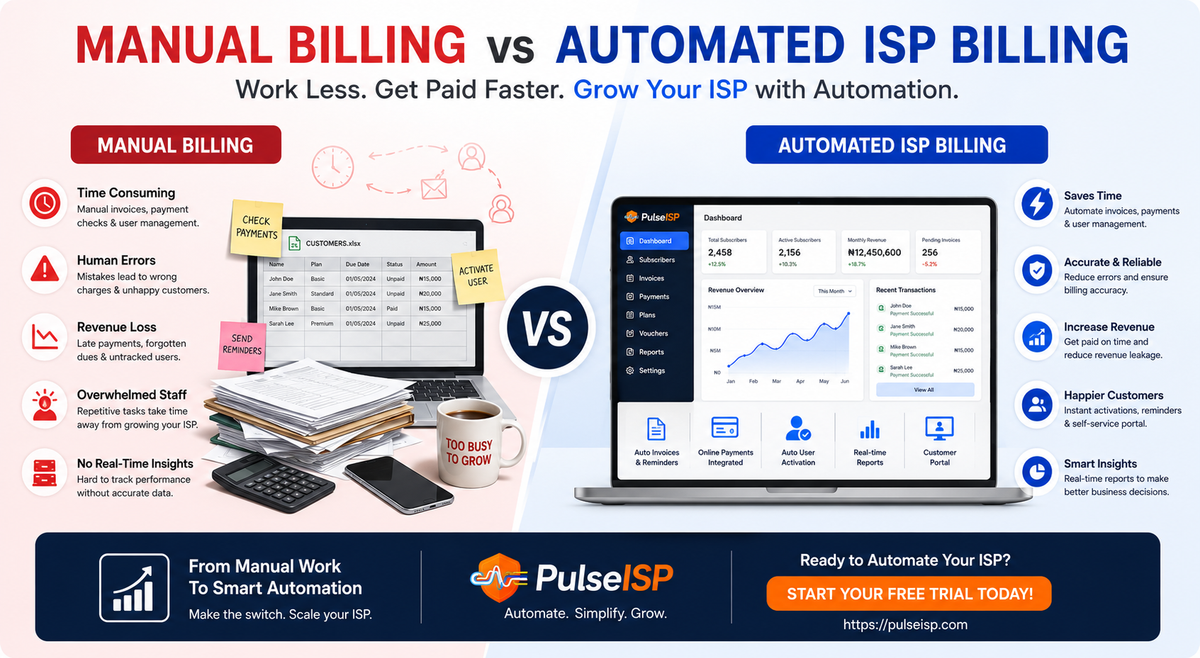
- Manual Billing vs Automated Billing
- The Hidden Cost of Manual Operations
- Benefits of Billing Automation
- Signs Your ISP Has Outgrown Manual Billing
- How PULSEISP Automates Your ISP
- Frequently Asked Questions
- Final Thoughts
Chapter 1
What Is Manual ISP Billing?
Manual ISP billing refers to managing subscribers, invoices, payments, and network access without an integrated billing platform.
Instead of relying on automation, staff perform most operational tasks manually using spreadsheets, banking apps, messaging platforms, and direct router configuration.
A typical manual workflow looks like this:
Customer Makes Payment

↓

Staff Checks Bank Alert

↓

Payment Confirmed

↓

Invoice Updated

↓

Technician Opens MikroTik

↓

Customer Activated

↓

Support Notified
For very small ISPs, this process may seem sufficient. However, as subscriber numbers increase, manual workflows become increasingly difficult to manage efficiently.
Common Manual Tasks
Most manually managed ISPs perform activities such as:
- Creating invoices individually
- Confirming payments manually
- Creating PPPoE accounts
- Creating Hotspot vouchers
- Activating subscribers
- Suspending unpaid customers
- Tracking subscriptions in Excel
- Sending WhatsApp reminders
- Updating bandwidth profiles manually
Each task consumes valuable time and increases the risk of human error.
Chapter 2
What Is Automated ISP Billing?
Automated ISP billing replaces repetitive manual tasks with software that manages subscriber accounts, billing, payments, and network automation from one centralized platform.
Instead of relying on staff to update routers after every payment, an automated system communicates directly with your MikroTik routers and performs these tasks instantly.
A typical automated workflow looks like this:
Customer Pays Online

↓

Payment Verified Automatically

↓

Invoice Marked Paid

↓

PULSEISP Updates MikroTik

↓

Customer Connected

↓

Receipt Sent

↓

Reports Updated
This entire process can take just a few seconds, providing customers with immediate service while reducing administrative work for your team.
Chapter 3
Manual Billing vs Automated Billing
| Manual Billing | Automated Billing |
|---|---|
| Excel spreadsheets | Centralized dashboard |
| Manual invoices | Automatic invoices |
| Bank alerts | Integrated payment gateways |
| Manual MikroTik updates | Instant API automation |
| Staff activation | Automatic activation |
| Manual suspension | Automatic suspension |
| WhatsApp reminders | Automated notifications |
| Limited reporting | Real-time analytics |
The difference isn't just speed—it's consistency, accuracy, and scalability. Automation reduces repetitive work, minimizes errors, and provides real-time visibility into your ISP's operations.
The Hidden Cost of Manual ISP Billing
Many ISPs believe manual billing saves money because they avoid paying for billing software.
In reality, manual operations often cost far more than a subscription to an automated platform.
The biggest costs aren't always obvious. They appear in the form of lost time, delayed activations, missed payments, and frustrated customers.
Let's look at a few common examples.
Delayed Customer Activations
Imagine a customer pays for internet service at 10:00 PM.
With a manual billing process, they may need to:
- Send a payment receipt on WhatsApp.
- Wait for office hours.
- Wait for someone to verify the payment.
- Wait for a technician to activate their account.
Depending on your operating hours, that customer could be waiting several hours—or even until the next business day.
With an automated billing platform, payment verification and activation happen almost instantly, giving customers immediate access to the service they've paid for.
Revenue Leakage
Manual processes make it easy for revenue to slip away unnoticed.
Examples include:
- Subscribers remaining connected after their subscription has expired.
- Forgotten invoices that are never sent.
- Customers accidentally assigned the wrong package.
- Payments that are received but never recorded.
- Voucher sales that aren't properly tracked.
Each issue may seem minor on its own, but together they can significantly impact profitability over time.
Increased Staff Workload
As your subscriber base grows, so does the amount of repetitive administrative work.
Your team may spend hours each day:
- Checking bank alerts.
- Updating spreadsheets.
- Creating invoices.
- Activating subscribers.
- Suspending overdue accounts.
- Answering billing questions.
This is time that could instead be invested in improving your network, onboarding new customers, or expanding into new coverage areas.
Human Error
No matter how experienced your staff are, manual processes always carry the risk of mistakes.
Common examples include:
- Entering incorrect payment amounts.
- Forgetting to suspend overdue subscribers.
- Activating the wrong customer account.
- Assigning incorrect bandwidth profiles.
- Missing subscription renewal dates.
Automation helps eliminate these repetitive tasks, reducing the likelihood of costly errors.
Benefits of Automated ISP Billing
Automation isn't simply about saving time—it's about creating a more efficient and scalable business.
Here are some of the biggest advantages.
Instant Subscriber Activation
Customers expect internet access immediately after making payment.
With automation, your billing platform verifies payment, updates your MikroTik router, and restores service automatically.
No phone calls.
No WhatsApp messages.
No waiting.
All done from the captive portal for hotspot or from customer portal for PPPoE
Automatic Invoice Generation
Instead of creating invoices manually every month, the system generates them automatically based on each subscriber's billing cycle.
This ensures consistency while reducing administrative effort.
Automatic Payment Reconciliation
Modern billing systems integrate directly with payment gateways.
Once payment is received:
- The invoice is marked as paid.
- The subscriber's account is updated.
- Internet access is restored if necessary.
- Payment records are stored automatically.
Everything happens without manual intervention.
Real-Time Reporting
Instead of relying on spreadsheets, you gain access to live business insights.
For example:
- Monthly revenue
- Outstanding invoices
- Active subscribers
- Expired accounts
- New customer registrations
- Popular internet plans
These reports help you make informed decisions and identify growth opportunities.
Better Customer Experience
Customers appreciate a service that's fast, reliable, and convenient.
Automation enables them to:
- Receive invoices on time.
- Pay online.
- Access customer portals.
- View payment history.
- Enjoy immediate service activation.
A smoother experience often leads to higher customer satisfaction and better retention.
Signs Your ISP Has Outgrown Manual Billing
How do you know it's time to move beyond spreadsheets and manual processes?
If any of the following sound familiar, your ISP has likely reached the point where automation can make a meaningful difference.
You're constantly checking bank alerts.
Customers frequently ask if you've received their payment.
Technicians spend hours creating or suspending subscriber accounts.
Your team manages customer information across multiple spreadsheets.
Billing takes several days each month.
Customers wait hours for internet activation.
You struggle to keep track of expired subscriptions.
Reporting requires exporting data into Excel.
Your subscriber base continues to grow, but your administrative workload grows even faster.
These challenges are common for growing ISPs and are often signs that manual processes are becoming a bottleneck.
How PULSEISP Automates Your ISP
PULSEISP was built to eliminate repetitive administrative tasks so ISPs can spend less time managing operations and more time growing their business.
Instead of juggling spreadsheets, messaging apps, payment notifications, and router configurations, PULSEISP brings everything together in one centralized platform.
With PULSEISP, you can:
- Automate subscriber onboarding.
- Generate recurring invoices automatically.
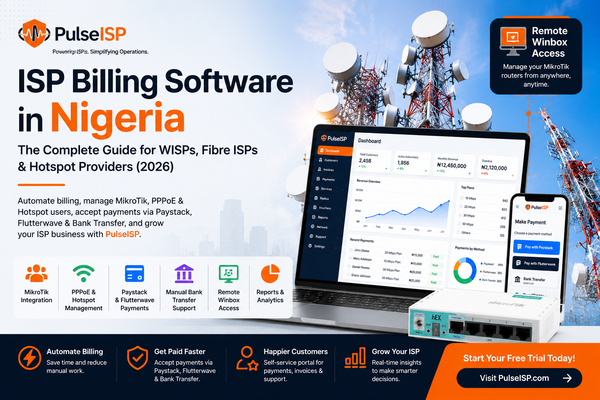
- Integrate with MikroTik routers for instant activation and suspension.
- Manage both PPPoE and Hotspot subscribers.
- Accept online payments through supported gateways.
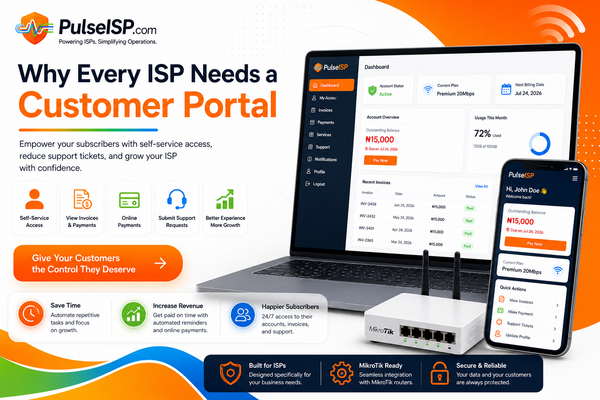
- Offer customers a self-service portal.
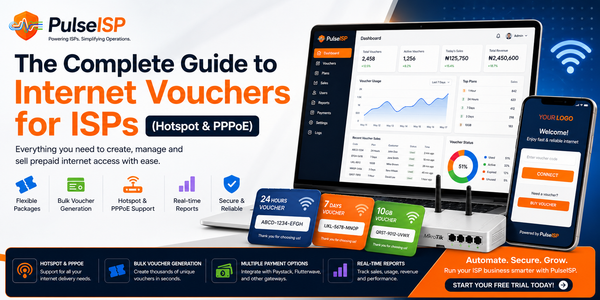
- Generate internet vouchers in bulk.
- Monitor revenue and subscriber activity in real time.
- Access reports and analytics from a single dashboard.
Whether you're managing 50 subscribers or several thousand, automation helps your ISP operate more efficiently while delivering a better customer experience.
How Automation Works with PULSEISP
Customer Pays Online
        ↓
Payment Verified Automatically
        ↓
Invoice Updated
        ↓
PULSEISP Communicates with MikroTik
        ↓
Subscriber Activated Instantly
        ↓
Customer Receives Confirmation
        ↓
Reports Updated Automatically
Frequently Asked Questions
Is manual billing suitable for small ISPs?
Yes. Many providers begin with manual billing when serving a small number of subscribers. However, as the business grows, automation typically becomes more efficient and easier to manage.
When should an ISP switch to automated billing?
There is no fixed number, but many providers begin experiencing operational challenges once they reach dozens or hundreds of active subscribers. The right time is usually when manual tasks start consuming more time than network growth.
Can automated billing work with MikroTik?
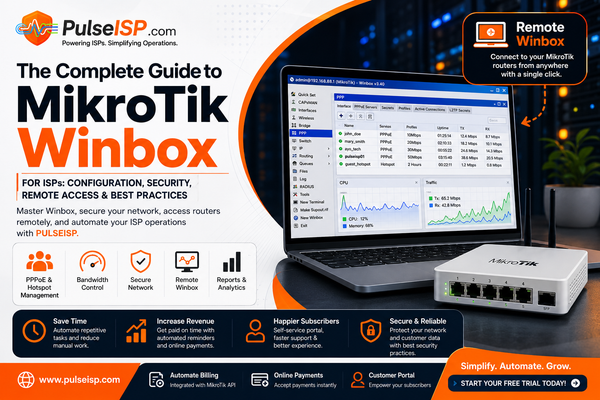
Yes. Modern ISP billing platforms integrate with MikroTik RouterOS to automate subscriber activation, suspension, bandwidth management, and authentication.
Does automation reduce support calls?
In many cases, yes. Features such as customer portals, online payments, automated notifications, and instant activations reduce the need for customers to contact your support team for routine account enquiries.
Can I still control my network manually?
Absolutely. Automation handles repetitive tasks, but administrators retain full control over network configuration and subscriber management.
Final Thoughts
Manual billing is often where every ISP begins, but it isn't where successful ISPs stay.
As your subscriber base grows, so do the challenges of managing invoices, payments, activations, and customer accounts manually. What once worked for a handful of subscribers can quickly become a barrier to growth.
Automating your billing operations doesn't just save time—it improves accuracy, enhances the customer experience, and gives you the tools to scale confidently.
By bringing billing, subscriber management, MikroTik integration, online payments, customer portals, and reporting into one platform, PULSEISP helps ISPs simplify daily operations while preparing for long-term growth.
Ready to Stop Managing Your ISP Manually?
If you're ready to replace spreadsheets, manual activations, and repetitive administrative work with a modern, automated platform, PULSEISP is ready to help.
With PULSEISP you can:
✅ Automate MikroTik subscriber management
✅ Generate recurring invoices
✅ Accept online payments
✅ Manage Hotspot and PPPoE users
✅ Provide a self-service customer portal
✅ Track your business with real-time reports
Start your free trial today and discover how PULSEISP can help you build a smarter, more efficient ISP.