ISP Billing Software: The Complete Guide for MikroTik ISPs
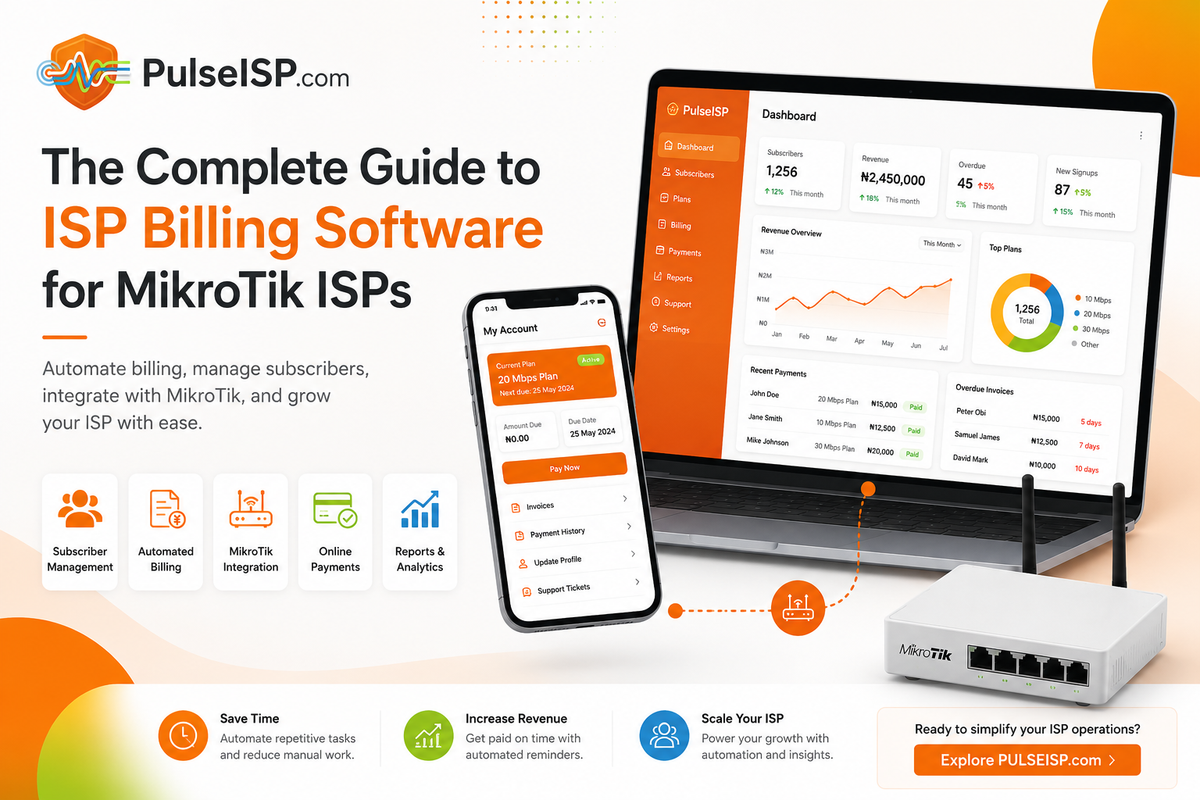
How Modern ISPs Automate Billing, Subscriber Management & MikroTik Networks Hardware

Introduction
Running an Internet Service Provider is about much more than delivering internet access.
In the early days, managing subscribers with spreadsheets, confirming payments from bank alerts, and manually creating PPPoE users on a MikroTik router can seem perfectly manageable. With only a handful of customers, these tasks take just a few minutes each day.
But as your subscriber base grows, so does the complexity of your business.
Suddenly, technicians are manually activating services, support teams are chasing payment confirmations, invoices are being missed, and overdue accounts remain connected longer than they should. Instead of focusing on expanding your network, your team spends more time managing day-to-day operations.
This is where ISP billing software becomes essential.
More than just an invoicing tool, a modern ISP billing platform connects subscriber management, billing, payment processing, customer support, and network automation into a single system. Instead of switching between multiple applications and manually updating routers, your team can manage daily operations from one centralized dashboard.
Whether you're operating a neighbourhood hotspot, a growing wireless ISP, or a fibre network powered by MikroTik, the right billing platform helps streamline operations, reduce administrative workload, and deliver a better experience for both your team and your subscribers.
In this guide, you'll learn what ISP billing software is, how it works, the essential features to look for, and how automation can help your ISP scale with confidence.
Table of Contents
• Why Manual ISP Management Stops Working
• What Is ISP Billing Software?
• Essential Features Every ISP Billing Platform Should Have
• How ISP Billing Software Works
• Why MikroTik Integration Matters
• Benefits of Automating Your ISP
• Choosing the Right ISP Billing Software
• Why Growing ISPs Choose PULSEISP
• Frequently Asked Questions
💡 Looking for an all-in-one ISP billing solution?
PULSEISP helps automate subscriber management, billing, MikroTik integration, and online payments—all from one dashboard.
Chapter 1: Why Manual ISP Management Stops Working
Every ISP starts small.
In the beginning, it's easy to keep track of subscribers using a spreadsheet, confirm payments from bank alerts, and manually create user accounts on your MikroTik router. With only a few customers, these tasks take just a few minutes each day.
As your business grows, however, those same processes become harder to manage.
Imagine adding 10 to 20 new subscribers every week while also handling renewals, support requests, payment confirmations, and service activations. Before long, your team is spending more time on repetitive administrative work than on expanding the network or serving customers.
The problem isn't your team—it's the process.
When billing, subscriber records, payments, and network management are handled separately, mistakes become inevitable. A customer may pay but wait hours before their internet is activated. An expired account might remain online because someone forgot to suspend it. Invoices can be delayed, and support staff often have to search through multiple systems just to answer a simple customer question.
These small issues may seem harmless at first, but together they lead to lost revenue, frustrated subscribers, and slower business growth.
Modern ISPs solve this challenge through automation. Instead of relying on spreadsheets, manual router configuration, and scattered payment records, they use a centralized platform that connects every part of the business—from customer registration and billing to network provisioning and payment processing.
The result is a business that runs faster, delivers a better customer experience, and can scale confidently as the subscriber base grows.
Chapter 2: What Is ISP Billing Software?
ISP billing software is much more than a tool for sending invoices. It is the central platform that manages your subscribers, automates billing, processes payments, and communicates directly with your network equipment.
Instead of using separate tools for customer records, payment tracking, router management, and reporting, everything is managed from a single dashboard.
When a new customer subscribes to an internet plan, the system creates their account, assigns the correct package, generates an invoice, and—depending on your setup—can automatically provision access on your MikroTik router once payment is confirmed.
The same automation continues throughout the customer's journey. Monthly invoices are generated automatically, payment reminders can be sent without manual follow-up, overdue accounts can be suspended based on your billing policy, and service is restored instantly after payment.
For your team, this means less time spent on repetitive tasks and more time focused on growing the business.
A modern ISP billing platform also provides valuable insights into your operations. From subscriber growth and monthly revenue to unpaid invoices and network usage, you always have a clear picture of how your business is performing.
As your ISP grows, having one system that connects your customers, payments, and network becomes essential—not only for efficiency but also for delivering a faster and more professional experience.
Chapter 3: Essential Features Every ISP Billing Platform Should Have
Not all ISP billing systems offer the same capabilities. While some focus only on invoicing, modern platforms are designed to automate nearly every aspect of running an internet service business.
Here are the core features every growing ISP should look for.
Subscriber Management
Every customer should have a complete profile that includes their contact information, subscribed plan, payment history, invoices, service status, and support records. Having everything in one place makes it easier for your team to provide fast and accurate customer support.
Automated Billing
Generating invoices manually every month wastes valuable time. A modern billing platform automatically creates recurring invoices, tracks due dates, applies late payment rules, and keeps your billing process consistent.
Payment Processing
Customers expect convenient payment options. Whether you accept bank transfers, Paystack, Flutterwave, Monnify, or mobile money, payments should be recorded automatically, reducing manual reconciliation and minimizing errors.
MikroTik Integration
For ISPs using MikroTik, integration is essential. The billing system should communicate directly with your routers to create subscribers, assign bandwidth profiles, suspend overdue accounts, and restore service automatically after payment.
Customer Self-Service Portal
A self-service portal allows subscribers to view invoices, make payments, update their information, and manage their internet plans without contacting support. This improves customer satisfaction while reducing your team's workload.
Notifications and Reminders
Automated SMS and email notifications help keep customers informed about new invoices, upcoming due dates, successful payments, service suspensions, and account updates. Consistent communication leads to fewer support requests and better payment compliance.
Reporting and Analytics
Running an ISP requires more than knowing who has paid. You need visibility into revenue, subscriber growth, overdue balances, plan performance, and overall business health. A good reporting dashboard helps you make informed decisions with confidence.
The right ISP billing platform brings all of these features together in a single system, allowing your team to spend less time on administration and more time delivering reliable internet services.

Chapter 4: How ISP Billing Software Works
One of the biggest advantages of ISP billing software is that it automates the entire customer lifecycle—from the moment someone signs up to their monthly renewals.
Here's a typical example.
A customer visits your website and chooses an internet package that fits their needs. They complete the registration form and submit their details.
The billing platform immediately creates a subscriber profile and prepares the selected service plan.
Once payment is received through your preferred payment gateway, the system verifies the transaction automatically. If everything is successful, it communicates with your MikroTik router to create the customer's account, apply the correct speed profile, and activate internet access.
The customer is connected within minutes—without anyone manually logging into the router.
The automation doesn't stop there.
Every billing cycle, the system generates a new invoice automatically and notifies the customer by email or SMS. If payment is made before the due date, the service continues uninterrupted.
If payment isn't received, the system follows the billing rules you've configured. It can send payment reminders, apply a grace period, and automatically suspend internet access if the account remains overdue.
As soon as the outstanding balance is paid, the subscriber's connection is restored automatically—eliminating delays and reducing support calls.
This level of automation helps ISPs deliver faster service, reduce administrative work, and ensure that billing and network management stay perfectly synchronized.
Chapter 5: Why MikroTik Integration Matters
MikroTik powers thousands of wireless and fibre internet providers because it's reliable, flexible, and cost-effective. But managing subscribers directly through RouterOS quickly becomes difficult as your customer base grows.
Without automation, every new subscriber requires someone to log into the router, create an account, assign the correct bandwidth profile, and configure access manually. The same process must be repeated whenever a customer upgrades their plan, forgets to pay, or renews their subscription.
These repetitive tasks consume valuable time and increase the chances of human error.
An ISP billing platform with MikroTik integration eliminates this manual work by communicating directly with your routers through the MikroTik API.
When a subscriber joins, their account can be created automatically. If they upgrade to a faster package, the new speed profile is applied instantly. If a payment becomes overdue, the system can suspend the connection based on your billing policy. Once payment is received, internet access is restored automatically without requiring technician intervention.
This seamless connection between your billing platform and your network ensures that subscriber management stays accurate, consistent, and efficient.
For growing ISPs, MikroTik integration isn't just a convenience—it's one of the key building blocks for delivering reliable service while keeping operational costs under control.
Chapter 6: Benefits of Automating Your ISP
Running an ISP involves much more than providing internet connectivity. Behind every active subscriber is a series of operational tasks—from billing and payment collection to customer support and network management.
Automation brings these processes together, allowing your business to operate more efficiently.
Some of the biggest benefits include:
Save Time
Tasks that once required hours of manual work—such as generating invoices, confirming payments, activating subscribers, or suspending overdue accounts—can be completed automatically.
Reduce Human Errors
Manual processes often lead to mistakes. Automation helps ensure invoices are generated correctly, payments are recorded accurately, and subscribers receive the correct service every time.
Improve Cash Flow
Automatic reminders encourage customers to pay on time, while faster payment processing and automatic service enforcement help reduce outstanding balances.
Deliver Better Customer Experiences
Subscribers expect quick activations, simple online payments, and instant service restoration after payment. Automation makes these expectations easier to meet while reducing the number of support requests your team handles.
Scale Without Growing Your Team
As your subscriber base increases, your workload shouldn't grow at the same rate. Automation enables your existing team to manage hundreds—or even thousands—of subscribers without becoming overwhelmed.
Ultimately, automation allows your ISP to spend less time on repetitive administration and more time expanding coverage, improving service quality, and growing the business.
Chapter 7: Choosing the Right ISP Billing Software
Selecting the right ISP billing software is more than comparing prices—it's about choosing a platform that can support your business as it grows.
The ideal solution should simplify daily operations, integrate seamlessly with your network, and provide the tools needed to deliver an excellent customer experience.
When evaluating an ISP billing platform, consider the following:
Easy Network Integration
If your ISP relies on MikroTik, your billing software should integrate directly with RouterOS. This enables automatic subscriber provisioning, bandwidth management, account suspension, and service restoration without manual intervention.
Flexible Billing Options
Every ISP operates differently. Look for software that supports recurring subscriptions, prepaid services, hotspot vouchers, one-time charges, and custom billing cycles to match your business model.
Multiple Payment Methods
Your customers should be able to pay using the payment methods they already trust, whether that's Paystack, Flutterwave, Monnify, bank transfer, or mobile money. Automatic payment reconciliation can save hours of manual work each month.
Customer Self-Service
A customer portal allows subscribers to view invoices, make payments, manage their accounts, and monitor their services at any time. This reduces support requests while improving customer satisfaction.
Reporting and Business Insights
Reliable reporting helps you understand subscriber growth, monthly revenue, overdue invoices, and overall business performance. Access to accurate data makes it easier to plan for expansion and make informed decisions.
Scalability
Choose a platform that can grow alongside your business. Whether you're serving 50 subscribers or 5,000, your billing system should remain fast, reliable, and easy to manage.
The right software doesn't just automate today's tasks—it provides the foundation for your ISP's future growth.
Chapter 8: Why Growing ISPs Choose PULSEISP
Running an ISP becomes more demanding as your subscriber base grows. Managing customer records, processing payments, handling support requests, and maintaining network access can quickly become overwhelming without the right tools.
PULSEISP was built to simplify these operations by bringing everything together in one platform.
Instead of switching between spreadsheets, payment records, and router configurations, your team can manage subscribers, billing, payments, and network automation from a single dashboard.
Designed with modern ISPs in mind, PULSEISP helps providers automate repetitive tasks while maintaining complete control over their operations.
With PULSEISP, you can:
- Manage subscribers from a centralized dashboard.
- Automate recurring billing and invoice generation.
- Integrate with MikroTik for automatic account provisioning and service management.
- Accept online payments through supported payment gateways.
- Provide customers with a self-service portal to view invoices, make payments, and manage their accounts.
- Monitor business performance through real-time reports and analytics.
Whether you're operating a small wireless ISP, managing multiple hotspots, or expanding a fibre network, PULSEISP provides the tools needed to reduce administrative work, improve customer satisfaction, and support long-term growth.
As your business grows, your software should grow with it—and that's exactly what PULSEISP is designed to do.
Frequently Asked Questions
What is ISP billing software?
ISP billing software is a platform that helps internet service providers manage subscribers, automate billing, process payments, and control network access from a single system. It reduces manual work while improving operational efficiency.
Can ISP billing software work with MikroTik routers?
Yes. Most modern ISP billing platforms integrate with MikroTik RouterOS, allowing them to automatically create subscriber accounts, assign bandwidth profiles, suspend overdue users, and restore services after payment.
Is ISP billing software suitable for small ISPs?
Absolutely. Whether you're managing 20 subscribers or several thousand, automation helps reduce administrative work and prepares your business for future growth.
Can customers pay online?
Yes. Many ISP billing systems support online payment gateways, allowing customers to pay their bills quickly and securely. Payments can be processed automatically, reducing the need for manual reconciliation.
Can customers manage their own accounts?
Most modern platforms include a self-service portal where subscribers can view invoices, make payments, update their information, and monitor their service without contacting support.
What are the benefits of automating ISP operations?
Automation saves time, reduces human error, improves cash flow, delivers a better customer experience, and allows ISPs to grow without significantly increasing administrative workload.